
I have accumulated quite a few bird identification field guides over
the years and I thought I had enough. But then came The
Warbler Guide by Tom Stephenson and Scott
Whittle.

Most every basic birding field guide will include
warblers, but The Warbler Guide takes it to
infinity and beyond that both beginner and expert birders will
appreciate.
Warblers are especially challenging to ID because
they move quickly, are often in dense habitat and they don’t sit around
to give you that perfect look with your bins.
Sometimes all you see is a flash of color, a
wingbar, throat patch, the underside of the tail, sometimes a
distinctive behavior, perhaps just a silhouette or a blur.
And then
it’s
gone. But fret no more.
The Warbler Guide
will enable you to
identify a warbler with limited information and teach you what’s
important to focus on for species identification.
Introduction of The Warbler Guide and Summary of
Features
Features:
- Includes all 56 warbler species in the U.S. and
Canada - Over 1,000 stunning color photos, an average
of 18 photos per warbler taken at multiple viewing angles,
including flight shots - Identification remarks to narrow down species
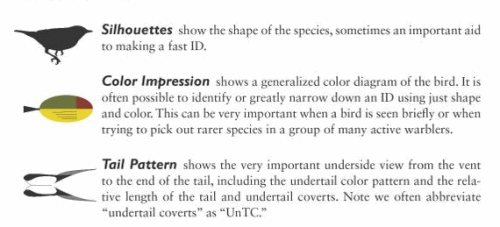
ID from silhouettes, color impression and tail pattern - Quick reference icons for range,
preferred habitat and behaviors - Sonograms for an easier way to learn bird
songs,
especially between similar species - Detailed distribution maps
- Complete aging and sexing descriptions
- Confusing fall warblers
- Regional plumage variations
- General tips on what to notice on a warbler,
how to listen to warbler songs, learning chip and flight calls - And much, much more!
Quick Reference Icons
At the top of the ID page for each species, there
is a single row of icons for silhouette, color, undertail,
range, habitat and
unique behaviors. This helps for narrowing down choices for quicker
identification.
Identification From Below – Yes, of Course!
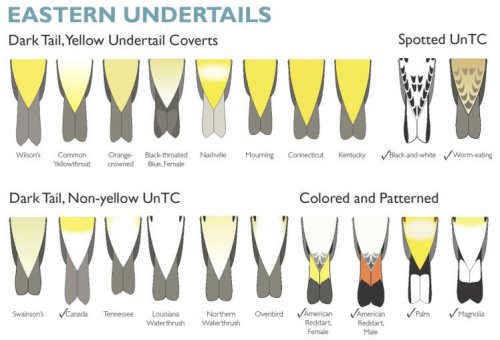
How many times do you see only the underside of a warbler that’s high
above you? Well they have it covered with undertail covert comparisons,
tail patterns from underneath, belly colors and even feather color
around the vent. Below is one example of eastern warbler undertails.
Lots of Photos and Details
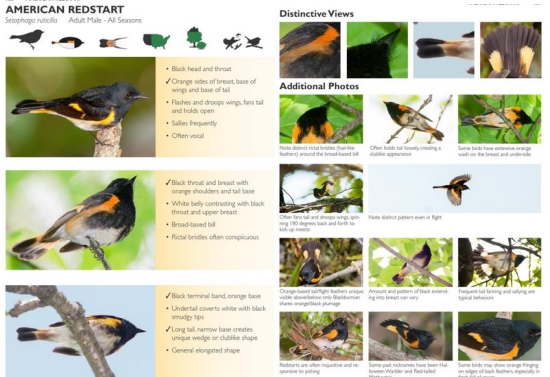
Below is an example of just two of the pages for
male American Redstart identification. It includes photos in many
different
angles, close-ups and even in-flight photos of the bird.
Each species account includes silhouette, color
pattern, undertail color and pattern, range, habitat and
behavior icons for quick reference; distinctive views, additional
photos, comparison species,
aging and sexing, range map, song description and sonograms.
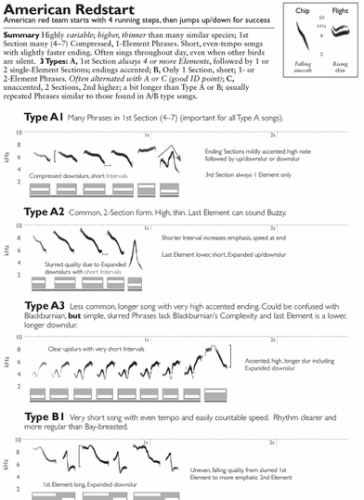
Song ID with Sonograms
Included are detailed descriptions of each species songs and call notes along
with sonograms (audio spectrograms).
Don’t worry if you don’t know how to interpret these.
The book gives a thorough explanation of how to use them. And once you do
learn how to use them, they will help you learn and identify warbler songs in
the field much more easily.
Many Gushing Reviews by Birders
I’ve never seen so many birders drool
over
a new field guide like this one. Here are some of the reviews:
Flexibound & Kindle Format with Audio
Guide Companion Available
You can purchase
The
Warbler Guide in flexibound book
and/or Kindle Format.
FYI, you do not have to own a Kindle in
order to use the electronic version. There are free Kindle apps that
allow you to view it
on your mobile devices (iPhone, Blackberry, Android, Windows),
iPad, Android or Windows tablet, on
your PC or Mac or simply in your browser.
I prefer the real book version myself, but note
it is larger than your average field guide. So if you don’t like
carrying large field guides around, you may prefer the Kindle
version.
There is also a Song and Call Companion audio
guide available from the Cornell Lab of Ornithology Macaulay
Library that
is presented in the exact page-by-page order as they occur in
the book. It costs $5.99 which I think is a steal.
When you click over
to Amazon, you can view inside the book to see more details.
This field guide would be great to use in your own
local area, but also especially useful on birding trips to new
locations.
I know I would have loved to have this book when guiding birding trips in
dense spruce-fir forests in Maine.
The warblers were
always
the most difficult and sometimes frustrating birds for people to ID.
It
would have been nice to have The Warbler Guide as another resource
for showing people what to look for.
Likewise, this book can help you when your birding buddies say, “All I saw
was…” and you reply, “No problem. Let’s take a look at my Warbler Guide!” 🙂
Warbler Watching Tips
Related Bird Field Guide & ID Pages:
Warbler
Guide Song and Call Companion
|
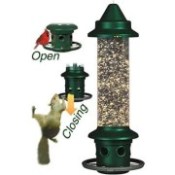
Our Favorite Bird Watching Binoculars, Squirrel-Proof Feeder & Hummingbird Feeder Read Our Reviews: |
||
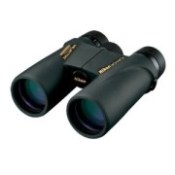
Nikon Monarch M5 Best mid-priced bird watching binoculars. Waterproof, shockproof, multi-coated ED-Glass. |
|

|
| Click Images or Links To View More Info | ||