The natural world is a symphony of interdependent relationships, and few are as fascinating as the cooperative strategies birds employ to secure their next meal. While many birds are solitary hunters, a remarkable number have evolved to work in tandem with other species, from insects to mammals and even humans, to find food. This collaboration highlights the ingenuity of nature, showcasing a spectrum of interspecies dynamics that range from mutually beneficial partnerships to clever, and sometimes parasitic, exploitation. These behaviors reveal a complex web of ecological connections where birds become more than just predators; they become partners, followers, or even thieves in the grand quest for sustenance.
The Antbirds: A Living Wall of Prey

Deep in the tropical forests of Central and South America, a unique and chaotic partnership unfolds on the forest floor. Army ants, an astonishingly aggressive and numerous insect species, embark on massive foraging raids, forming a living, pulsating carpet of millions of individuals. As this army advances, it flushes out every insect, spider, lizard, and small amphibian in its path.

This is where the antbirds come in. These birds, comprising dozens of species from several families, have evolved a specialized foraging strategy centered entirely on following these ant raids. They do not eat the ants themselves, which are fiercely aggressive and armed with powerful mandibles. Instead, they feast on the panicked creatures fleeing the ant swarm. A single antbird might snatch dozens of grasshoppers, roaches, and other invertebrates in a matter of minutes, simply by perching at the edge of the raid and picking off the escapees. This relationship is a perfect example of commensalism: the birds gain a highly efficient food source, while the ants are largely unaffected. The antbird’s survival is so intrinsically linked to the ants that some species, known as obligate ant-followers, will only forage at the edges of army ant swarms and will go to great lengths to find a raid to follow.
Crows and Ravens: The Followers of the Hunt

In the vast wildernesses of North America and Eurasia, a different kind of partnership unfolds between birds and large predators. Common Ravens (Corvus corax) and American Crows (Corvus brachyrhynchos) are renowned for their intelligence and their opportunistic feeding habits. While they are capable of hunting small prey on their own, they often rely on the hunting prowess of other, larger carnivores.

These clever birds will closely follow wolf packs, bears, or coyotes. They are not a part of the hunt, but they know that a successful hunt will result in a feast of carrion that they can access. Their excellent eyesight allows them to spot a kill from a great distance, and their loud cawing and squawking can sometimes alert other scavengers, including their own kind. Once the wolves or bears have finished their meal, the ravens and crows swoop in to pick at the scraps and bones left behind. In a sense, they are ‘working with’ the predators by acting as a cleanup crew, a commensal relationship that allows the birds to conserve their energy and gain access to a food source they couldn’t possibly acquire on their own.
Gulls: The Marine Scavengers

On the open seas, marine birds have developed a keen understanding of the behavior of marine mammals, particularly when it comes to finding food. Herring Gulls (Larus argentatus) and other gull species are famous for their scavenging, but their skills extend to following hunting pods of killer whales, dolphins, or seals.

These birds do not hunt the fish themselves, nor do they try to compete with the powerful mammals. Instead, they position themselves strategically around the hunting pod. As the mammals drive schools of fish to the surface and tear into them, scraps and stunned fish become available. The gulls, with their light frames and quick reflexes, dive to the surface to snatch the leftovers. This behavior is highly effective and saves the birds a significant amount of energy compared to fishing on their own. The relationship is a simple one-way street, a classic example of commensalism where the birds benefit from the foraging efforts of their mammalian companions.
Crested Caracaras: The Digging Opportunists

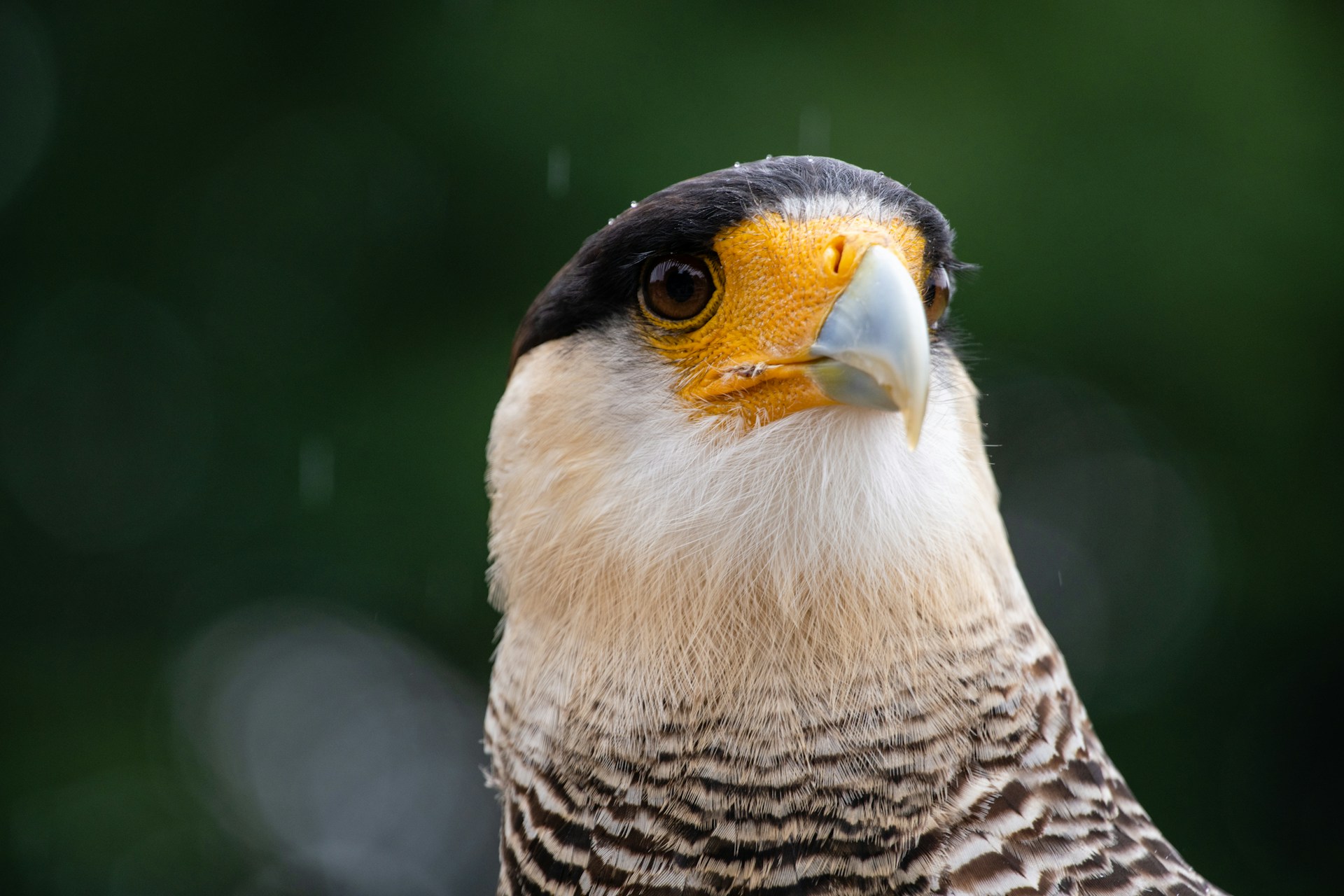
In the grasslands and savannas of the Americas, from the southern U.S. to South America, the Crested Caracara (Caracara plancus) is a large, terrestrial raptor known for its intelligence and versatile diet. Unlike many falcons, it is not a high-speed hunter, but rather an omnivorous scavenger that takes advantage of whatever resources are available.

One of their most fascinating foraging behaviors is their habit of following animals that dig for food, such as armadillos, badgers, or even peccaries. As these mammals tear up the ground in search of roots, grubs, and insects, they expose a buffet of potential meals for the caracara. The bird will walk closely behind the digging mammal, patiently waiting for a grub or a lizard to be uncovered. This partnership is a testament to the caracara’s adaptability and its ability to turn the hard work of another species into an easy meal. While the relationship is primarily commensal, it demonstrates a bird’s remarkable ability to recognize and exploit a profitable foraging strategy.
The Drongo: A Deceptive Forager

The Fork-tailed Drongo (Dicrurus adsimilis) of Africa is a master of mimicry and a clever, if dishonest, collaborator. Drongos often forage in close proximity to larger mammals, like meerkats, and other birds. As these animals hunt, they flush out insects and small prey, which the drongo can easily swoop in and catch—a simple commensal relationship.

However, the drongo’s true genius lies in its ability to take advantage of its partners. The drongo can mimic the alarm calls of various species, from meerkats to hornbills. When a drongo sees a meerkat with a juicy insect or a bird with a captured lizard, it will emit a convincing alarm call, tricking the other animal into dropping its food and fleeing for cover. The drongo then swoops down and steals the meal. This is a form of kleptoparasitism, a sophisticated act of theft that relies on the trust and communication of other species. Despite this deceptive behavior, drongos still provide an early warning system for some animals, as they are vigilant birds that are quick to sound a legitimate alarm.
Final Thoughts
The world of interspecies foraging is a rich and diverse one, revealing that survival is often about more than just brute strength or speed. From the jungles of South America to the open plains of North America, birds have forged ingenious alliances with a wide array of other species. Whether they are patiently waiting behind a wall of biting ants, soaring above a pack of wolves, or following a digging armadillo, these birds demonstrate a remarkable level of adaptability and ecological intelligence.
Their unexpected partnerships are a powerful reminder that in the grand theatre of nature, collaboration and opportunity are just as important as competition. They challenge our simple notions of predator and prey, revealing a world where every creature, from the largest mammal to the smallest bird, is interconnected in a complex and ever-evolving web of life.