
Ever notice how a hummingbird returns to the same spot in your garden, day after day, even year after year? Whether it’s a feeder, a patch of red tubular flowers, or a favored perch, these tiny birds seem to know your yard like a familiar map. Is it possible they remember it? The answer is a resounding yes, and the reasons why are fascinating.

A Hummingbird’s Memory Allows It To Navigate Familiar Spaces
Hummingbirds don’t just flit around at random. These birds possess an extraordinary spatial memory, which allows them to create mental maps of their feeding territories. Scientists have observed that hummingbirds can recall specific locations of flowers, their bloom timing, and even the routes between feeding spots. In one study, rufous hummingbirds were shown to remember which flowers they had already drained and how long it would take for each to refill with nectar.

So when a hummingbird returns to your yard, it’s not by chance; it’s because your yard is part of its remembered territory.
Why Hummingbirds Might Choose Your Yard
Certain yards offer a perfect combination of resources: consistent nectar feeders, native flowering plants, water sources, and safe perches. Once a hummingbird discovers a yard that meets these criteria, it may revisit it multiple times a day—and even return to it across seasons. This behavior is particularly common in species like the ruby-throated hummingbird, which are known to revisit the same yards and gardens each year during migration.

If you’ve noticed repeat visitors, especially at the start of the season, you’re probably seeing birds who mapped your yard in previous years and remembered it as a reliable food stop.
Territorial Recall: Not Just About Food
Memory helps hummingbirds defend their turf. Males often establish feeding territories and remember the boundaries they’ve set, including the presence of rivals. If another hummingbird dares to trespass, the original “owner” reacts quickly, indicating not just vigilance, but a clear memory of which spaces belong to whom.
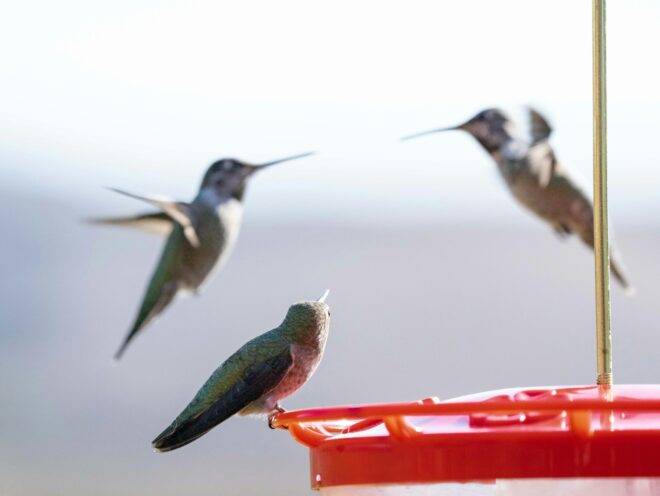
This means that when you see a hummingbird chasing others away from “its” feeder, it’s not acting randomly. It remembers your yard as part of its personal space and is enforcing that remembered boundary.

Do Hummingbirds Return After Migration?
Surprisingly, yes. Some banding studies suggest that individual hummingbirds can return to the exact same feeders or gardens after migrating thousands of miles. These return visits suggest long-term memory capacity far beyond what most people assume of a bird that weighs less than a nickel.
So, when spring rolls around and a hummingbird buzzes your porch days after you’ve hung a feeder, chances are, it remembers you and your yard from last year.
Final Thoughts
Hummingbirds don’t just pass through. They map, memorize, and return to the places that serve them well. If your yard offers good food, shelter, and safety, it’s likely to become part of a hummingbird’s mental landscape, for a season, years, or possibly the rest of its life.
So the next time one of these aerial acrobats hovers by your flowers or feeder, know this: your yard isn’t just a stopover, it’s a remembered haven in a hummingbird’s fast-paced world.