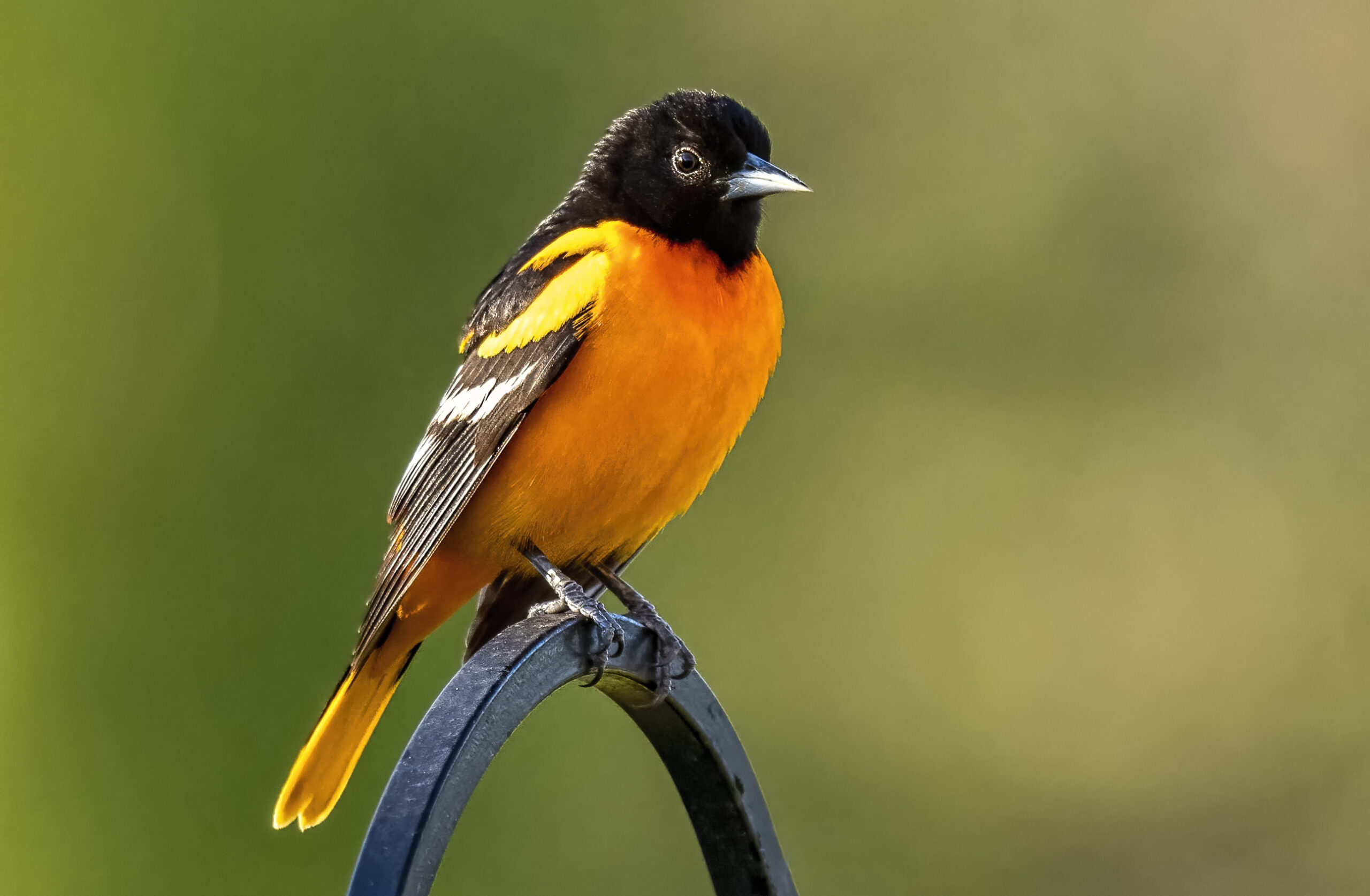
Birds are some of nature’s most vibrant creatures, displaying an incredible array of colors and patterns. While their feathers are not the only thing that defines them, there’s no denying that their colors play a big role in their beauty and identification.
Among the many color variations in birds, those with bright yellow chests stand out as some of the most striking.
1. American Goldfinch

- Scientific name: Spinus tristis
- Length: 4.3 – 5.1 inches
- Weight: 0.4 – 0.7 ounces
- Wingspan: 7.5 – 8.7 inches
The American Goldfinch is a small, brightly colored songbird commonly found across North America. It’s a year-round favorite at backyard feeders, especially in the summer when males display their vibrant yellow plumage with a black cap and black wings.
Key Facts:
- In winter, both males and females molt into a dull olive-brown plumage.
- American Goldfinches primarily eat seeds, particularly from thistles and sunflowers.
- Unlike many birds, they delay nesting until mid-to-late summer to align with peak seed availability.
- They are the state bird of Iowa, New Jersey, and Washington.
- Brown-headed Cowbirds often lay their eggs in goldfinch nests, but the cowbird chicks rarely survive due to the goldfinch’s seed-based diet.
2. Western Tanager

- Scientific name: Piranga ludoviciana
- Length: 6.3 – 7.3 inches
- Weight: 0.8 – 1.3 ounces
- Wingspan: 11 – 11.5 inches
Male Western Tanagers resemble flames, with fiery orange-red heads, bright yellow chests, and contrasting black wings and tails. Females are more subdued, featuring a yellowish body and grayish wings.
Key Facts:
- They breed in coniferous forests of the western U.S. and Canada and migrate south to Mexico and Central America for winter.
- Their red head coloration comes from a pigment found in their insect diet rather than being produced naturally.
- Their song is a series of short, hoarse phrases, similar to an American Robin but more monotonous.
- Males perform a courtship display by tumbling in midair to attract females.
3. Audubon’s Oriole

- Scientific name: Icterus graduacauda
- Length: 7.5 – 9.4 inches
- Weight: 1.1 – 1.9 ounces
- Wingspan: 12.3 – 12.6 inches
Audubon’s Oriole is a striking bird with a yellow body and a jet-black head, wings, and tail. Unlike most orioles, both males and females share the same coloration.
Key Facts:
- Found mainly in Mexico and the southernmost parts of Texas.
- Prefers wooded areas with thick vegetation, making it a shy and elusive species.
- Unlike many orioles, it frequently visits bird feeders that offer fruit, jelly, or nectar.
- Often parasitized by Bronzed Cowbirds, which lay their eggs in oriole nests.
4. Yellow-bellied Sapsucker

- Scientific name: Sphyrapicus varius
- Length: 7.1 – 8.7 inches
- Weight: 1.5 – 1.9 ounces
- Wingspan: 13.4 – 15.8 inches
The Yellow-bellied Sapsucker is a medium-sized woodpecker known for drilling rows of holes in tree bark to extract sap. It has a black-and-white body, a red forehead, and a pale yellow wash on its chest.
Key Facts:
- Breeds in Canada and the northern U.S. and migrates south for winter.
- Feeds primarily on tree sap but also consumes insects and fruit.
- Its drumming sounds distinct, often described as irregular and stuttering.
- Other birds, like hummingbirds and warblers, sometimes feed from the sapsucker’s drilled holes.
5. Couch’s Kingbird

- Scientific name: Tyrannus couchii
- Length: 7.9 – 9.4 inches
- Weight: 1.2 – 1.4 ounces
- Wingspan: 14 – 16 inches
Couch’s Kingbird is a large, aggressive flycatcher with a bright yellow chest and gray head. It closely resembles the Tropical Kingbird but can be distinguished by its unique call.
Key Facts:
- Found year-round in Mexico and southern Texas.
- Hunts insects midair and occasionally eats berries and seeds.
- Named after American naturalist Darius Nash Couch, who first identified the species in 1853.
- Its call sounds like a sharp “kip-kip-breeet” followed by a chattering series of “bret-bret-bret.”
6. Tropical Kingbird

- Scientific name: Tyrannus melancholicus
- Length: 7.1 – 9.1 inches
- Weight: 1.1 – 1.5 ounces
- Wingspan: 15 – 16 inches
Similar in appearance to Couch’s Kingbird, the Tropical Kingbird is found across South and Central America and occasionally in the southern U.S. during summer.
Key Facts:
- Often found near water, especially along rivers and lakes.
- Builds nests close to wasp nests for protection against predators.
- Feeds on large flying insects like wasps, dragonflies, and beetles.
- Recognizable by its rolling “pit prrrrrr” call.
7. Yellow-breasted Chat

- Scientific name: Icteria virens
- Length: 6.7 – 7.5 inches
- Weight: 0.8 – 0.9 ounces
- Wingspan: 9.1 – 10.6 inches
The Yellow-breasted Chat is the largest warbler in North America, often mistaken for a thrush due to its stocky build. It has a yellow chest, an olive-green back, and a white eye-ring.
Key Facts:
- Found in dense shrubby habitats across the U.S. during the breeding season.
- Known for its odd, varied song, which includes whistles, hoots, and clucks.
- Eats both insects and berries, making it an omnivorous warbler.
- Displays unusual behavior for a warbler, such as holding food in its feet while eating.
8. Palm Warbler

- Scientific name: Setophaga palmarum
- Length: 4.7 – 5.5 inches
- Weight: 0.3 – 0.5 ounces
- Wingspan: 7.9 – 8.3 inches
The Palm Warbler is a small, ground-foraging songbird with a yellow chest and a distinctive habit of wagging its tail constantly.
Key Facts:
- Breeds mainly in Canada and winters in the southeastern U.S. and the Caribbean.
- Has two subspecies: one with bright yellow plumage (eastern) and one with duller colors (western).
- Often seen hopping along the ground, unlike most other warblers.
- Sings a simple, buzzy trill during the breeding season.
FAQs
Are there other orioles with yellow chests?
Yes, the Bullock’s, Scott’s, Hooded, and Spot-breasted all have orange on their fronts while the Altamira, Baltimore, Streak-backed, and Orchard Orioles are more orange.
What are the yellow-breasted birds from Central America?
The Golden-bellied Flycatcher is resident on the northern tip of South America and through Central America to Costa Rica. It doesn’t reach the U.S.
What small bird has yellow on its chest and neck?
The Yellow-throated Warbler has yellow on the throat and top of the breast. It can be found on the eastern side of the U.S., through the west to a lesser extent, and into Central America.
Final Thoughts
From tiny goldfinches to striking orioles and bold kingbirds, these yellow-chested birds bring color and character to their habitats. Many can be spotted across North America, so whether you’re birdwatching in your backyard or exploring forests and grasslands, keep an eye out for these stunning species!